Read the fine print before the check.
A franchise attorney charges $2,000–$5,000 to review one Franchise Disclosure Document. We've read all 2,000+ of them — and lay out the real numbers, strengths, and risks for $49.
Delivered in minutes · No account required · 3-pack $99
fit your budget
Every figure comes from the filing — not the brochure.
We extract Items 5, 6, 7, 19, and 20 straight from each franchisor's legally-filed FDD, benchmark them against the category, surface the strengths, and flag the risks. We don't grade brands and no one pays to change what we report.
How we make money: buyers pay for reports, and — only when you opt in to be contacted — franchise development teams pay us a referral fee for the introduction. Neither one changes our analysis, ratings, or verdicts. See our Disclaimer and Privacy Policy.
See exactly what $49 gets you.
Not a mockup — a complete, Item 19-verified analysis of Panera, LLC. You get this same depth for any of 2,000+ franchises, personalized to your capital and market.
Proven brand equity and a clear multi-unit path — but the unit economics need operating margins above 15% to justify the capital.
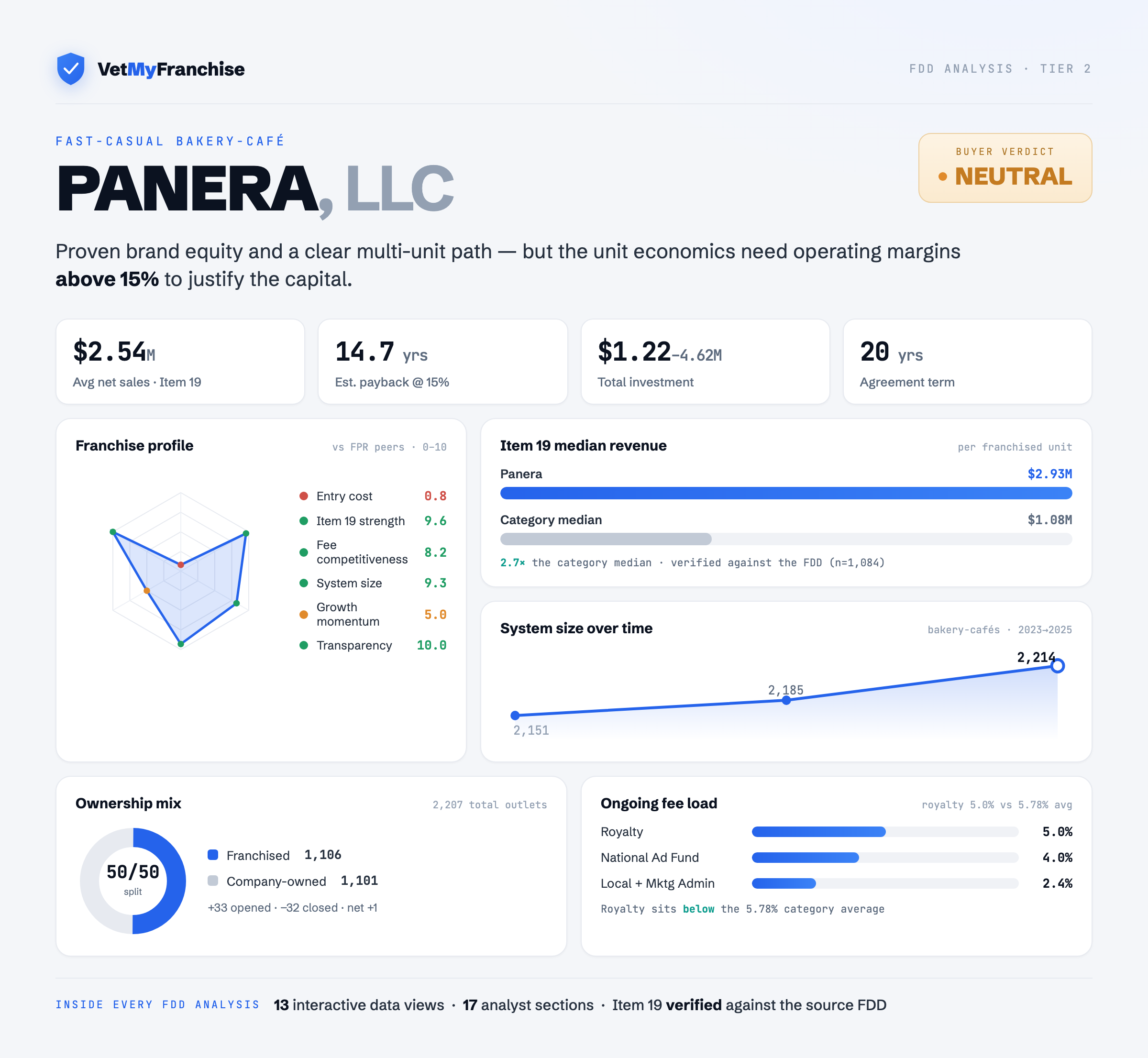
Neutral — Panera offers proven brand equity and a clear multi-unit development path, but unit economics require margins above 15% to justify the capital within a reasonable payback horizon.
…the full memo continues with “Proceed only if…” conditions and this week’s 3 phone calls (with the exact questions to ask active and former franchisees).
Run this exact analysis on the franchise you're considering — personalized to your capital and market, delivered in minutes.
No subscription · Pay per analysis · Item 19 verified against the source FDD
Why VetMyFranchise?
Brokers earn commissions. Raw FDD sites leave you on your own. We give you objective, structured FDD analysis — free to start.
Free · No credit card · Results in 30 seconds
Everything below is free · No account needed
More free franchise data than anyone else.
Free Executive Summary
A plain-English AI summary of any franchise — the verdict, key facts, and questions to ask — on every one of the 2,000+ pages, no email required.
Side-by-Side Comparison
Compare up to 4 franchises across 12 key metrics — investment, fees, units, Item 19, growth rate, and more.
Industry Benchmarks
See how a brand's fees and size rank against its category — percentile rankings built from every FDD we've read.
Compare brands on the figures that matter.
| Franchise | Item 19 | Investment (low–high) | Median unit rev | Royalty | Item 3 suits |
|---|---|---|---|---|---|
| Wingstop | Disclosed | $325k – $948k | $1,690,000 | 6.0% | 2 |
| Tropical Smoothie Cafe | Disclosed | $315k – $662k | $1,074,000 | 6.0% | 1 |
| The UPS Store | Partial | $190k – $480k | $793,000 | 5.0% | 4 |
| Jan-Pro | None | $5k – $58k | — | 10.0% | 6 |
▪ SOURCE: 2024 FDDs · ITEM 7 / 19 / 3 · ILLUSTRATIVE
Three steps from curious to confident.
Search and compare for free
Explore 2,000+ franchises. Read executive summaries, compare up to 4 side by side, and see benchmark rankings. No account — everything's open.
Get a personalized report
Buy the full 12-section FDD analysis for $49. Sections 9–12 are personalized to your capital, location, and concerns.
Invest with your eyes open
Walk into the conversation knowing the fees, the Item 19 math, the litigation, and the exact questions to ask the franchisor.
The numbers a sales rep won't lead with.
A brochure shows you the dream. The FDD shows you the math. We pull the figures that actually predict whether you'll make money — and put them first. Scroll to declassify.
Get the full breakdown — $49Free tools. Premium reports when you're ready.
- ✓Executive summaries on all 2,000+
- ✓Side-by-side comparison
- ✓Industry benchmarks
- ✓Questions to ask the franchisor
- ✓All 12 sections + Decision Memo
- ✓Item 19, fees, litigation, unit economics
- ✓4 sections personalized to you
- ✓Delivered in minutes
- ✓3 full reports, your pick
- ✓Save $48 vs single reports
- ✓Best for shortlisting
Not sure it's worth it? See a real $49 report, start to finish →
A franchise attorney charges $2,000–$5,000 for an FDD review that takes days. Our report is a fast, structured research starting point — not a substitute for legal review. We recommend using it alongside professional legal advice for major investment decisions.
Before you buy.
How is this different from hiring a franchise attorney?
Franchise attorneys typically charge $2,000–$5,000+ for an FDD review that takes days or weeks. VetMyFranchise gives you a structured 12-section FDD analysis in minutes for $49 — a research starting point, not a substitute for legal review. We recommend using our report alongside professional legal advice for major investment decisions.
What do I get for free?
Every franchise includes a free executive summary with key stats, red and green flags, and questions to ask the franchisor. You also get free access to our franchise comparison tool (up to 4 side by side) and industry benchmarks showing how each franchise ranks against peers. No account needed.
What is a Franchise Disclosure Document (FDD)?
An FDD is a legal document that franchisors must provide to prospective buyers. It contains 23 items covering everything from fees and litigation history to financial performance. We extract and structure the disclosures from these documents to surface the insights that matter most.
What does the $49 Research Report include?
A comprehensive 12-section analysis personalized to your situation — including financial fit analysis based on your capital, location-specific insights, competitive positioning with industry benchmarks, risk assessment, and red flags.
How fast do I get my report?
Most reports are generated and delivered to your email within minutes of purchase. You also get a secure download link that you can access anytime.
How do industry benchmarks work?
We analyze FDDs across 2,000+ franchises to build industry averages and percentile rankings. When you view a franchise, you see how its investment costs, fees, and system size compare to other franchises in the same industry.
How much does it cost to buy a franchise?
Initial franchise fees typically range from $10,000 for low-cost service brands to $75,000+ for established national chains, with total startup investment commonly between $75,000 and $500,000 once you add real estate, equipment, inventory, training, and working capital. Each FDD discloses the full investment range in Item 7. VetMyFranchise lets you compare the total investment range across 2,000+ franchises side by side.
What is the difference between the franchise fee and the total investment?
The franchise fee (disclosed in Item 5) is the one-time payment for the right to use the brand and system — typically $20,000 to $75,000. The total investment (Item 7) includes the franchise fee PLUS real estate, build-out, equipment, signage, inventory, training, insurance, and 3-6 months of working capital. A $40,000 franchise fee can easily mean $300,000+ in total cash needed to open the doors.
Which franchises have the lowest startup cost?
Home-services, cleaning, mobile, and online-based franchises typically have the lowest startup costs — many under $50,000 total investment when you skip retail real estate. VetMyFranchise lets you filter the 2,000+ franchise library by investment range to find concepts that fit your available capital.
What is Item 19 in a Franchise Disclosure Document?
Item 19 is the Financial Performance Representation — the only place in an FDD where the franchisor can disclose actual revenue or earnings figures from existing units. Disclosure is OPTIONAL: only about half of franchisors include an Item 19. When present, it usually shows average or median revenue per unit, sometimes broken down by location size or tenure. A missing Item 19 is a yellow flag — not necessarily disqualifying, but you should ask the franchisor why.
What is a royalty rate in franchising?
The royalty rate (disclosed in Item 6) is the ongoing percentage of gross revenue you pay to the franchisor for the duration of your agreement. Typical royalties range from 4% to 8% of gross sales, paid weekly or monthly. There may also be a separate ad fund contribution (often 1% to 3%) on top of the royalty. Higher royalties demand higher unit economics to make sense for the franchisee.
Do I need a lawyer to buy a franchise?
Yes — you should always have a franchise attorney review the FDD and Franchise Agreement before signing. VetMyFranchise gives you a structured breakdown of every FDD section so you can identify the issues to discuss with your attorney, but it does not replace legal review. Most franchise attorneys charge $2,000 to $5,000 for a full FDD review.
Can veterans get discounts on franchise fees?
Many franchisors offer veteran discounts on the initial franchise fee — commonly 10% to 25% off, sometimes higher. Programs vary widely; the discount is disclosed in Item 5 of the FDD. The International Franchise Association maintains a VetFran directory of participating brands. VetMyFranchise reports surface fee discounts where they appear in the FDD.
How do I evaluate whether a franchise is a good investment?
Look at the full picture: total investment vs. your available capital, royalty and ad-fund rates against industry medians, system size and growth trend (Item 20), litigation history (Item 3), and any financial performance disclosed in Item 19. Talk to existing franchisees from the Item 20 contact list — they will tell you what really happens after you sign. VetMyFranchise structures all of this into a single 12-section deep-dive report.
Ready to vet your next franchise?
Start free with a summary of any brand. Upgrade to the full $49 FDD analysis when you're ready to get serious.